Listen and watch now on YouTube, Apple, and Spotify.
Indeed increased AI coding tool adoption from roughly 25% to 97% across its engineering organization, but getting engineers to use the tools was only part of the challenge.
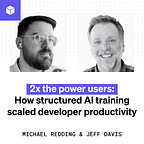
In this session from DX Annual, Michael Redding, Principal Product Manager, and Jeff Davis, VP of Core Infrastructure at Indeed, explain how the company used structured training, leadership support, and ongoing community engagement to help more than 2,000 engineers build practical AI skills. They share why an early train-the-trainer model fell short, how they redesigned their approach around hands-on learning, and what they learned about balancing adoption, measurement, and psychological safety.
They also discuss the impact of the program on coding time, the role of continuous enablement after formal training ended, and how Indeed is preparing for the next phase of AI adoption, including agentic workflows and AI-powered coaching.
Some takeaways:
Indeed started with a productivity problem, not an AI problem
At the beginning of 2025, Indeed’s DX survey showed that only about half of developer time was being spent on new features and innovation. The remaining 48% was consumed by maintenance, upgrades, incident response, and other forms of engineering overhead.
The company’s AI strategy focused on two goals: reducing overhead work and increasing output during coding time. The long-term objective was to double engineering productivity by shrinking non-value-added work while helping engineers produce more during the time they spend building.
AI Coding Essentials succeeded where AI Coding Ambassadors fell short
Indeed’s first enablement effort, AI Coding Ambassadors, used a train-the-trainer model built around roughly 60 AI champions across the organization. While ambassadors maintained high levels of engagement, adoption among their teammates declined after the program ended.
The company responded by launching AI Coding Essentials (AICE), a structured training program designed for all engineers. The experience convinced the team that direct, hands-on learning was far more effective than relying on knowledge to spread organically through teams.
Indeed treated AI upskilling as a company-wide investment
Training more than 2,000 engineers required significant organizational commitment and leadership support. Michael estimated the investment at roughly $3–4 million in engineering time across the company.
Rather than mandating AI usage, Indeed strongly encouraged completion of the training itself. Managers were given visibility into participation, while engineers retained flexibility in how and whether they ultimately incorporated AI into their workflows.
AI adoption increased from 25% to 97%
Despite offering AI tools, training resources, and executive support, weekly AI usage remained stuck around 25% at the start of 2025. The challenge was not tool access but helping engineers develop practical skills and confidence.
By the time of the presentation, weekly AI tool usage had reached approximately 97%. The company also successfully navigated multiple tool transitions, moving from Cody and Copilot to newer agentic tools such as Claude Code, Cursor, Windsurf, and Amp.
Structured training produced measurable results
Engineers who completed AI Coding Essentials reduced coding time by roughly 35–36%, while engineers who did not complete the training saw little change. Across the broader organization, coding time decreased by roughly 20%.
Indeed measured coding time as the period between a developer picking up a Jira ticket and opening a diff in GitLab. The company continued to see benefits months after training ended, especially as newer frontier models became available.
Community and continuous enablement kept momentum going
Indeed reinforced learning through coding forums, office hours, hackathons, Slack communities, and its AI Showcase recognition program. More than 100 unique community posts were being shared monthly in the company’s primary AI channel.
The goal was to make AI learning continuous rather than event-based. Engineers had multiple ways to share discoveries, get help, and learn from peers long after formal training concluded.
The next challenge is moving beyond coding
Indeed is now focused on agentic workflows, AI coaching, and expanding enablement beyond software engineering. Product managers, designers, researchers, and other R&D functions are becoming part of the company’s AI adoption strategy.
As coding becomes faster, bottlenecks are beginning to shift elsewhere in the development lifecycle. The team is already monitoring signs that code review and other downstream activities may become the next constraints on engineering throughput.
In this episode, we cover:
(00:00) Intro
(01:05) Indeed’s DX survey from January 2025
(02:30) The two-part strategy to double engineering productivity
(04:21) How Indeed increased AI adoption from 25% to 97%
(15:40) Results from Indeed’s AI training program
(18:33) How Indeed sustains AI adoption and learning
(23:06) What’s next for AI enablement at Indeed
(24:41) Q&A: How coding time was calculated
(25:25) Q&A: How Indeed uses AI playbooks
(26:40) Q&A: Balancing asynchronous and live AI training
(28:22) Q&A: Psychological safety during AI adoption
(31:44) Q&A: Why AI adoption spikes after the holidays
(33:20) Q&A: The metrics Indeed tracked
(35:22) Q&A: Where the time savings are going
(36:54) Q&A: Reaching engineers who skipped the training
(38:08) Closing thoughts
Referenced:
• Indeed
• Claude Code | Anthropic’s agentic coding system
• Cursor
• Windsurf
• Amp Code
• The Complete Guide to Building Skills for Claude | Anthropic