


Welcome to the latest issue of Engineering Enablement, a weekly newsletter sharing research and perspectives on developer productivity.
🗓 Join Abi on March 19th for a live Q&A session. He will address some of the more pressing questions we’ve received around measuring AI impact, the impact of tool choice, and more. Register here.
Edit: We've updated the data in this post to reflect the latest results from our longitudinal study.
Social media and vendor marketing have set high expectations for AI, suggesting as much as 2-3x productivity gains. But from the data we’re seeing, the reality on the ground is far more modest.
At DX, we’re currently conducting a longitudinal study to measure the long-term impact of AI adoption on key engineering productivity metrics. As part of this study, we analyzed data from a random sample out of 400 companies between November 2024 through February 2026 to track whether teams are shipping more pull requests as AI adoption increases.
We found that, during this time, AI usage increased significantly—by an average 65%. However, PR throughput only increased by 7.76%.
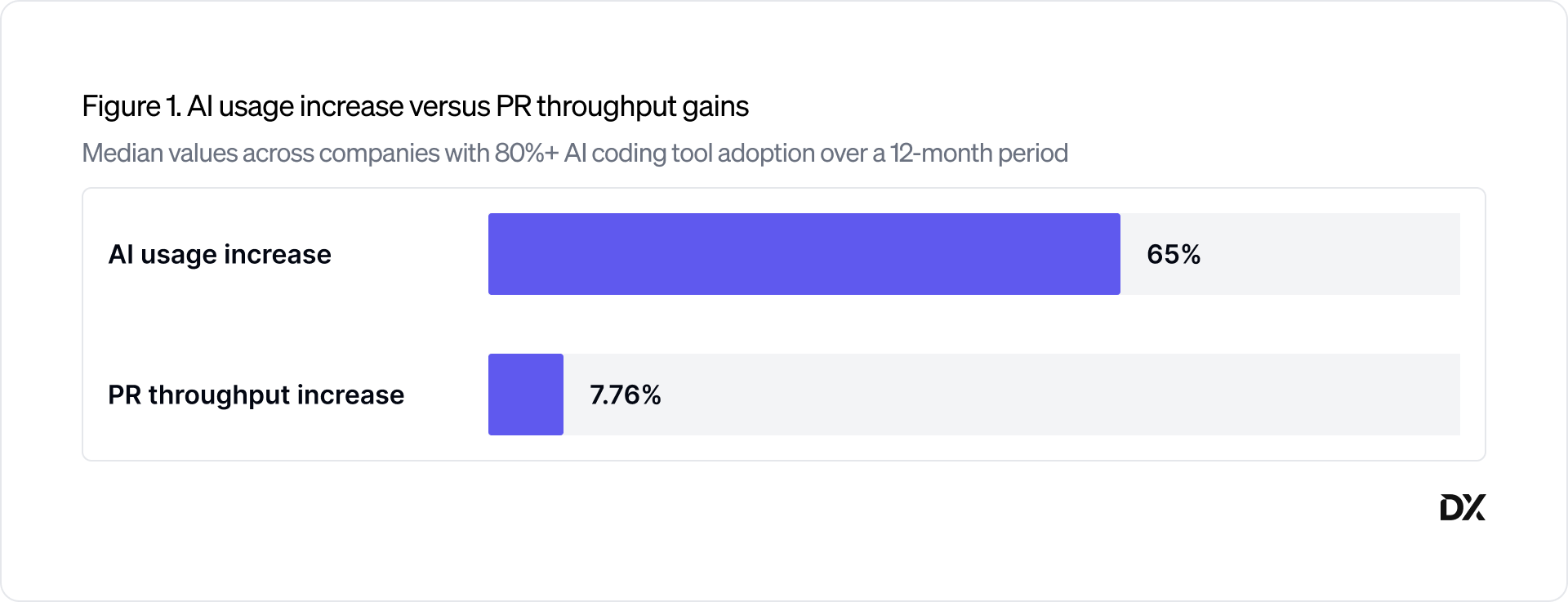
Note: This figure is particularly robust because we’ve filtered out potential gamification effects by excluding teams that set PR throughput targets for individual engineers, which could drive metric inflation rather than genuine output.
What this means for leaders
A ~10% gain is consistent with what we’re hearing from engineering leaders more broadly: most organizations are landing in the 5–15% range. It is a real improvement, but it’s a long way from the 2–3x gains many executives and boards have come to expect. AI is moving the needle, but leaders may need to reset expectations internally.
Why gains aren’t higher
To understand what’s driving this, we spoke with developers across several of these organizations. The explanation we heard most consistently: writing code was never the bottleneck.
As one senior developer put it: “The easy tasks are a little easier. The tedious tasks are a little less annoying. A four-day task might take three. But that doesn’t mean I’m shipping 3x more PRs.”
AI may be accelerating the coding portion of the job. But coding represents a relatively small slice of how engineers actually spend their time. Planning, alignment, scoping, code review, and handoffs—the human parts of the SDLC—remain largely untouched.
What’s next
We’re continuing to investigate the long-term effects of AI in engineering teams. The full study will explore why some teams are capturing more of the upside than others, and what leaders can do to close that gap. More to come.
This week’s featured DevProd job openings. See more open roles here.
Amplitude is hiring an Engineering Manager, Cloud Platform | San Francisco, CA
Figma is hiring a Staff Software Engineer, Developer Experience | Remote; US
Plaid is hiring a Software Engineer - Platform | New York, NY
UserTesting is hiring a Software Engineer, Developer Experience (Platform) | Spain
Vercel is hiring a DX Engineer | Hybrid (Austin, New York City, San Francisco)
That’s it for this week. Thanks for reading.
Thanks for sharing the results on PR throughput increases. The ~10% productivity gains are also in line what we've found from talking to engineering organizations in Switzerland. While this is nowhere near the 30-60% improvements that some consultants and vendors claim, it's still significant and valuable.
I've shared more details and thoughts on the matter last week on my Substack: https://flowlabs.substack.com/p/4-todays-3060-ai-productivity-gains
Thanks for sharing! Where can I read the full research?
The report doesn’t talk about PR size or feature delivery rate.
What I’ve seen is that PR size has increased as well. But the impact on feature delivery is not clear.