



Welcome to the latest issue of Engineering Enablement, a weekly newsletter sharing research and perspectives on developer productivity.
Join us tomorrow for DX’s next webinar. Eirini Kalliamvakou will be discussing where AI-related time savings are going, with Annie Vella and Nathan Hunt, a Principal Software Engineer at Snowflake. Sign up today.
Scott: For the last two weeks, our Field CTO Justin Reock has been laying the groundwork for how to 10x your engineering organization in the age of AI. Starting by dispelling the myth of the 10x developer (hopefully for good this time) and then charting the evolution of developer metrics frameworks, now we need to bring it all together.
This week, Justin lays out the foundations for a healthy engineering organization in the age of AI, and which metrics you need to track to unlock the 10x potential of your teams.
Over to you, Justin.
Justin: In our last two installments, we’ve established that 10x organizations are built on environments supporting deep focus, and that traditional metrics borrowed from the factory floor only tell part of the story.
We also know that when organizations measure the wrong things, they fall victim to Goodhart’s Law, where well-intentioned measures backfire, leading teams to optimize for the metric rather than the actual business outcome.
To build a high-performing engineering culture that avoids these pitfalls, engineering leaders must align their continuous improvement strategies behind a unified, holistic set of metrics.
The Developer Experience Index as a roadmap
Relying solely on quantitative data is an incomplete strategy, while relying purely on qualitative surveys is difficult and costly to execute. The solution is a developer-centric approach that measures the lived experience of engineers, as well as the efficiency of the surrounding platform, culture, and environment.
Last week, I charted the path from DORA, SPACE, and DevEx to the DX Core 4, a comprehensive distillation of the three mainstream productivity measurement frameworks.
Rolling this framework out requires a shift in how management views productivity. It is not just about installing a dashboard, it’s about recognizing how foundational drivers such as local iteration, incident response, documentation, and dev environments funnel directly into the productivity outcomes sought by leadership.
When you improve these specific drivers, the Developer Experience Index (DXI) rises, which directly influences the organization’s critical outcomes: speed, ease of delivery, quality, engagement, and efficiency. Ultimately, this is about adopting a mindset of continuous improvement, and using the DXI to maintain up-to-date situational awareness of the greatest impediments to productivity, so that they can be intervened upon and remediated.
Although I much prefer the narrative of optimal developer experience leading to increased throughput and value generation, the DXI can also provide us with a cost-based return on investment (ROI) of these improvements. For every 1-point improvement organizations can achieve in their DXI, they return about 10 hours a year per engineer in reduced waste, toil, and friction.
Aligning behind a single set of metrics
One of the most powerful aspects of aligning engineering leadership behind a single, standard, agreed upon set of metrics is the ability to align the organization’s definition of productivity, while preserving the autonomy engineering leaders need to improve their teams.
Well-intentioned leaders often create their own strategy for measurement and improvement. Some may choose DORA, others SPACE, and many will come up with their own set of metrics. While this may lead to short term improvements, over time these fragmented strategies can cause major organizational misalignment.
This misalignment can be difficult to detect at the team level, because engineering leaders following their own strategies feel that they are doing the right thing. This trust and autonomy provides a sense of personal satisfaction, which is important, but can create a false sense of direction. In other words, that necessary autonomy can lead to falsely positive sentiments about overall organizational improvement. This is a very precarious position to be in.
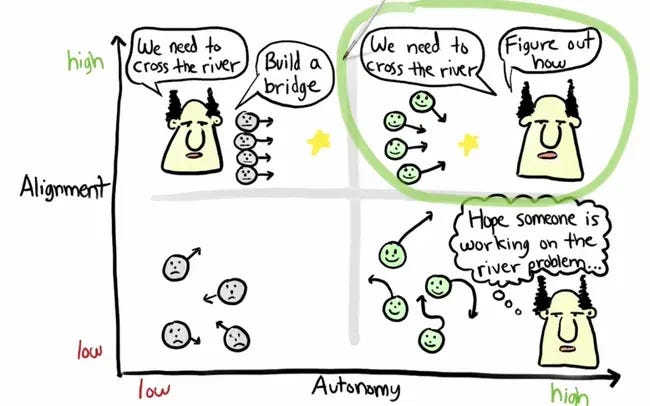
The lower right quadrant of Kniberg’s cartoon represents the state of misaligned autonomy that engineering organizations often find themselves in. Notice that while leaders are happy, the organization isn’t moving in the same direction.
By prescribing the Core 4 as the accepted metric set, and having engineering leaders agree to base their continuous improvement initiatives in response to these signals, the organization can achieve what Spotify refers to as “aligned autonomy” behind continuous improvement of their platforms, systems, and culture in which engineers work.
How AI changes this
With the rapid proliferation of AI agents and assistants, the baseline for many of these metrics are shifting. According to our most recent benchmarks, AI adoption swelled to over 95% weekly active users across surveyed organizations by Q2 2026. This all but eliminates the control group of “non-AI users.” AI-authored code now makes up roughly 62% of all new code, marking a 15% jump from just the previous quarter, and there aren’t clear signs of this slowing down.
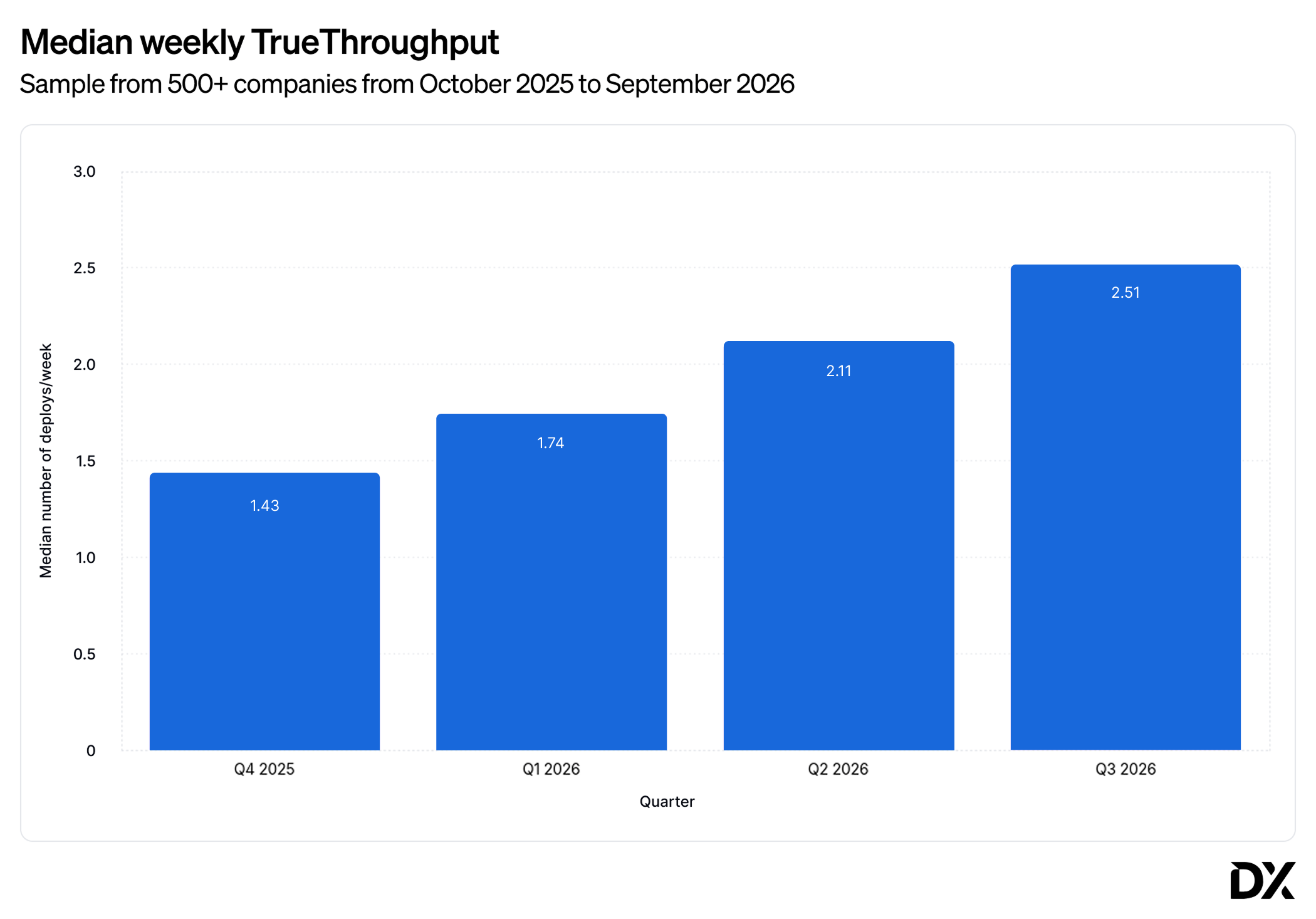
This scale of code generation is driving measurable and significant speed improvements across the industry. Median weekly TrueThroughput, DX’s proprietary weighted PR throughput metric, grew consistently. Additionally, AI is drastically shrinking the time it takes for new hires to add value. The median time to a new developer’s 10th merged PR plummeted from 70 days in Q3 2025 to just 30 days in Q2 2026.
With unprecedented speed comes new friction and escalating costs.
PR sizes have grown 122% over four quarters, and this verbosity, along with increased throughput, is shifting the bottleneck directly onto human reviewers. Organizations generating high volumes of AI code (80+%) now wait twice as long for a first review compared to organizations generating lower volumes (20-40%). There are numerous factors likely at play here, including the growing size of PRs, and swelling review backlogs.
Meanwhile, the financial reality of this transformation is setting in. Median AI spend at larger organizations (750+ developers) accelerated sharply, growing 3x quarter-over-quarter. Across all organization sizes, token spend grew roughly 21x over the past four quarters.
The true bottlenecks remain human
Despite these massive AI investments and the rapid acceleration of code generation, the data reveals a sobering truth: non-AI factors, such as meeting-heavy days and interruptions still outweigh AI benefits.
When analyzing the annualized distribution of developer time, the cost of meeting-heavy days, which remain stubbornly flat, and the cost of interruption frequency completely eclipse the time savings provided by AI tools.
AI metrics like token spend and AI-assisted PR percentages measure what is happening, but your Core metrics (like the DX Core 4) measure whether these investments are working.
Although AI is accelerating parts of our pipeline, the underlying organizational physics have not changed.
To build a 10x organization, you must find and fix the bottleneck. That bottleneck was never the speed at which we can write code, it is the environment in which we ask our engineers to review, collaborate, and focus.
Fix human bottlenecks to build 10x engineering organizations
Building a 10x organization requires an environment that minimizes interruptions to prioritize developer focus. Measuring this success evolved from traditional manufacturing and DORA metrics into the developer-centric SPACE framework.
To unify measurement, modern teams use the DX Core 4 to optimize flow state, feedback loops, and cognitive load. While AI massively accelerates code generation, it also creates new bottlenecks like inflated pull requests and longer review times.
Because human friction, like meeting-heavy days, still outweighs AI time savings, leaders must focus on resolving environmental constraints, not just writing code faster.
-Justin