



Welcome to the latest issue of Engineering Enablement, a weekly newsletter sharing research and perspectives on developer productivity.
Our latest webinar with the ex-Distinguished Engineer at Westpac New Zealand and researcher, Annie Vella, explores where AI-generated capacity may be going and how to reinvest it in higher-value work. Watch the discussion here.
Scott: As Marc Andreesen predicted 15 years ago, software has eaten the world. The past two weeks have been a stark reminder of that.
A global outage to Microsoft’s Outlook email service ground many businesses to a halt (a week too early to down tools and play GTA VI, sadly for some).

This was swiftly followed by software issues that grounded planes and impacted banks. The conspiracy theorists were having a field day.
While there is little evidence that software systems have gotten less reliable over time, increasing system complexity, the introduction of unfettered AI agents, and an increase in cyber risk thanks to the capabilities of advanced AI models, all adds up to a challenging time for anyone responsible for maintaining critical software systems.
As Brian writes this week, we have been here before (if you’re young enough to remember Y2K), and there are some lessons to be learned from the effort to avoid that disaster in today’s world. Over to you, Brian.
Brian: Outlook was disrupted for an entire day. A network failure prompted a nationwide airline grounding in the United States. Then a software bug at Chase delayed banking transactions, which impacted other banks.
All in all, it has been an unsettling couple of weeks for anyone who depends on software.
What worries me is how hard recovery can be. Microsoft’s preliminary report describes servers coming back online only to be overwhelmed again. Its automated recovery processes weren’t designed for such a widespread failure, and normal rollback controls couldn’t quickly reverse a change made months earlier.
Now consider what happens as AI tools help us change these systems faster. If verification and shared understanding don’t keep pace, we risk introducing more defects and leaving teams even less equipped to diagnose and repair them.
A familiar problem on a shorter clock
Back in 1999, Y2K turned the small programming decision to store years as two digits instead of four, into worldwide anxiety about whether essential services would keep working. Changing a date field was straightforward. The hard work was finding where that assumption had spread, testing the fixes, and coordinating the organizations affected.
Because of that hard work, modern society didn’t come crashing down when the clock struck midnight on January 1st, 2000. Today, an agent can spread a mistaken assumption across a codebase in an afternoon. We have much less time to notice when our understanding is falling behind.
That is the premise of Y2K on a Shorter Clock, my new ACM Queue article co-authored by research colleagues at Oregon State University, Anita Sarma and Rudrajit Choudhuri. The fundamentals of good engineering still apply.
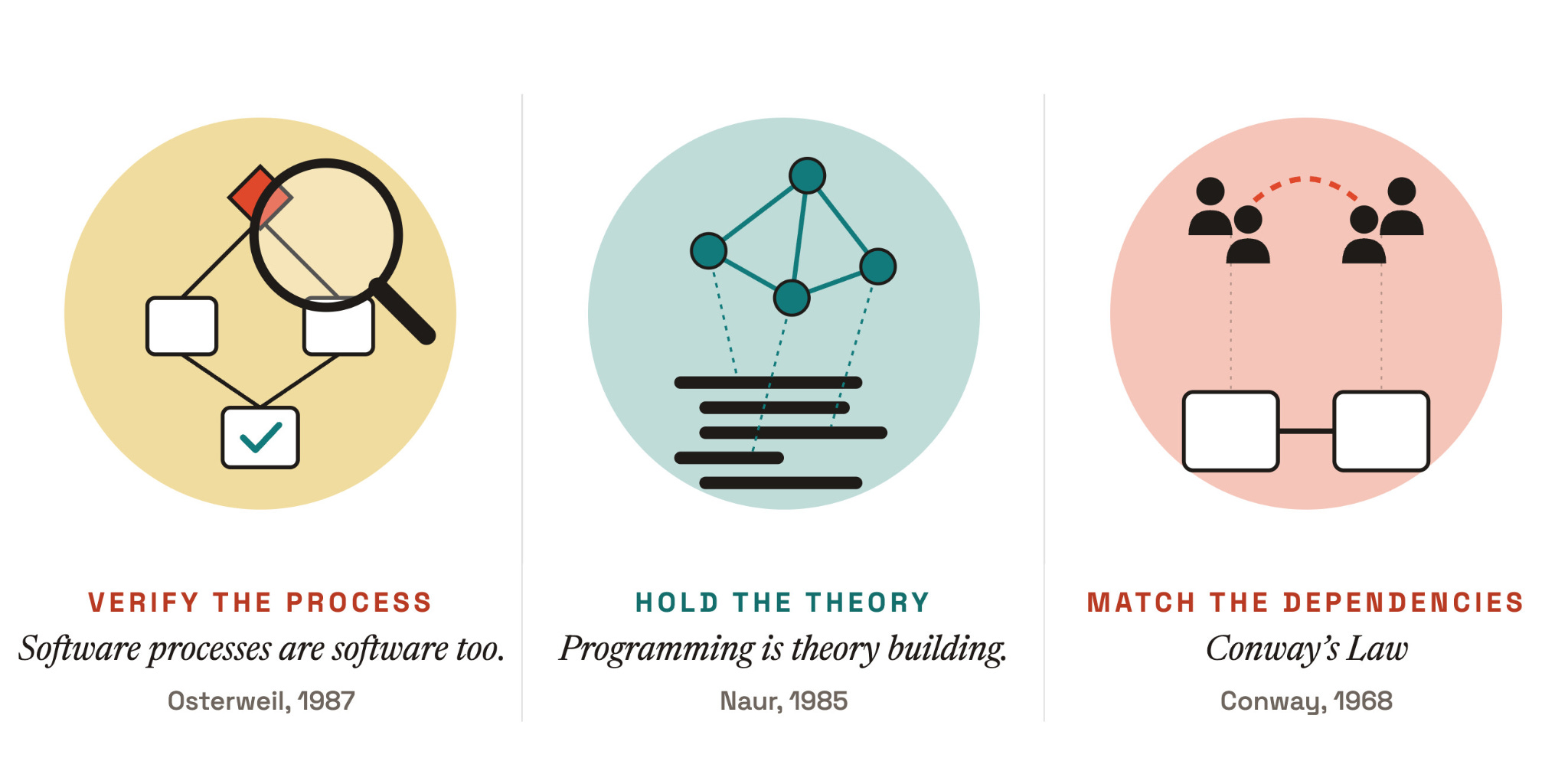
Software processes are software too
An agent can misunderstand a requirement, write code from that misunderstanding, and produce tests and documentation that agree with it. Seeing a passing test, in that case, provides confidence about the wrong thing.
In 1987, Leon Osterweil, then a computer science professor at the University of Colorado Boulder, presented Software Processes Are Software Too at the International Conference on Software Engineering (ICSE). His argument was that software development processes are themselves software, something we can specify, inspect, and improve. For an agent workflow, that means examining how it reached the result and what evidence supports it.
Programming is theory building
In 1985, Danish computer scientist Peter Naur published Programming as Theory Building. Naur argued that the act of programming builds a theory in people’s heads. Generating the code itself was one output, but the theory of how the system works, why it was built that way, and how to change it safely was equally important. Delegating coding work to agents removes the mechanism that a developer would have built that theory from.
The next person called into an incident may inherit the code without the reasoning needed to interpret it. That is a problem even when the code itself is readable.
Systems reflect communication structures
In 1968, computer scientist Melvin Conway published How Do Committees Invent? His observation, now known as Conway’s Law, connects the systems we build with the ways we communicate. Agents can now change another team’s code without telling the owners. The agent moves fast, and then the owners inherit the review and maintenance.
A change can pass its local tests while breaking assumptions another team relies on. Coordination has to reach the people responsible for fixing any problems, even if the agent didn’t need their input to make the change.
No silver bullet
These practices require time and attention. An engineer who spends an afternoon tracing downstream effects may ship less than someone who accepts an agent’s output immediately. If we reward output alone, we discourage the work we need when systems fail.
A checklist won’t resolve that incentive problem. Agents can generate reassuring records as easily as code. The useful question is whether someone else can use the evidence to evaluate the change and understand its consequences.
I’d start with one component where agents are making substantial changes. The table below gives the team a few concrete practices to try.
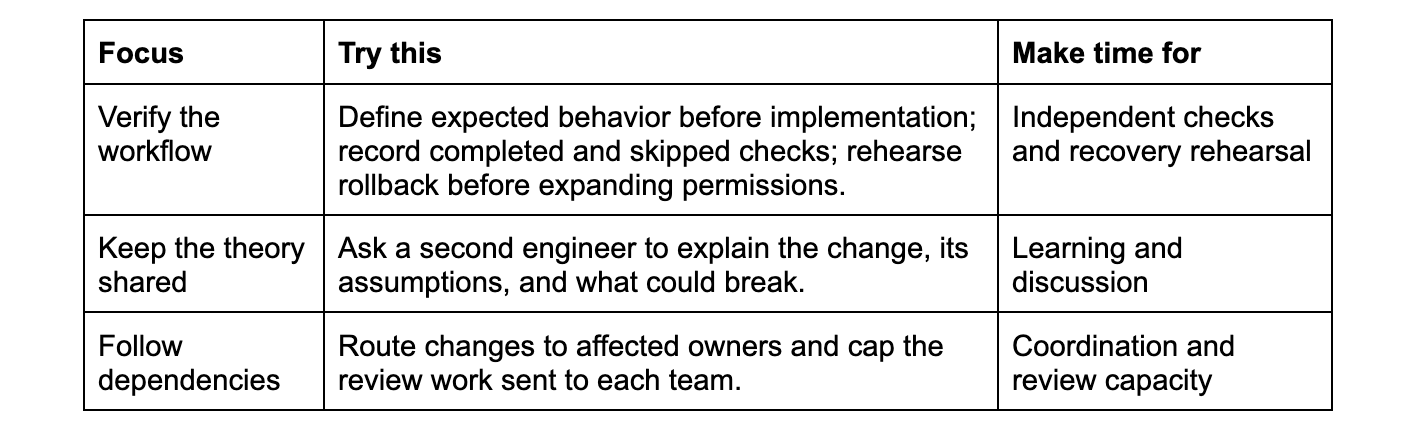
A condensed starting point from the article. Each practice requires work that output measures can miss.
Bring a recent agent-generated change to your next team discussion. Can someone who wasn’t in the session explain its assumptions, identify the affected owners, and show how its behavior was checked? Could they explain how to recover if it failed? If not, you have a specific place to improve before increasing the pace.
Our ability to produce software needs to be matched by our ability to keep it working.
- Brian
Your Conway's Law section worries me most. An agent can change another team's code without telling them, and that team inherits the review. I'd write down which repos each agent may touch, with one named owner per agent. A change outside that list then becomes something you can catch.
Very well put! I think AI maxis would argue that: the agent can diagnose and fix any issues, so why does the developer need to have that deep understanding?