
Listen and watch now on YouTube, Apple, and Spotify.
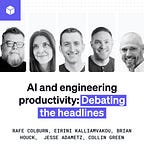
In this closing panel from DX Annual, Rafe Colburn, Chief Product and Technology Officer at Etsy; Jesse Adametz, Senior Director of Engineering, Platform Engineering at Twilio; Eirini Kalliamvakou, Research Advisor at GitHub; Collin Green, Senior Staff UX Researcher at Google; and Brian Houck, Senior Principal Applied Scientist at Microsoft debate some of the biggest questions surrounding AI and engineering productivity.
They discuss whether AI will reduce the need for engineers, how AI is affecting technical debt, the future role of software engineers in an agentic world, and whether organizations should mandate AI adoption. They also explore how bottlenecks are shifting across the software development lifecycle, the challenges facing junior engineers, and why learning, culture, and change management may ultimately matter more than the tools themselves.
Some takeaways:
AI is changing software engineering, but not eliminating the need for engineers
The panel largely rejected the idea that an AI-first SDLC means dramatically fewer engineers. As the cost of building software decreases, demand for software is likely to increase, creating new opportunities rather than eliminating the need for technical talent.
Several panelists argued that the role of software engineers will evolve rather than disappear. The tasks that make up the job may change, but organizations will continue to need people who can solve problems, make decisions, and build systems.
Technical debt remains a tradeoff, not just an AI problem
Panelists disagreed on whether AI is creating technical debt faster than it can remove it. Some argued that AI is accelerating both code generation and technical debt, while others believed the underlying business pressures that create technical debt remain largely unchanged.
The discussion also introduced the idea of cognitive debt. As engineers rely more heavily on AI-generated code, understanding and maintaining systems may become more difficult even if development velocity increases.
The future engineer may work at a higher level of abstraction
Several panelists predicted that engineers will spend less time writing code directly and more time defining intent, setting constraints, providing context, and validating results. Rather than replacing engineering work, AI may shift it to a different level of abstraction.
The panel also pushed back on the idea that engineers will simply become managers of agents. Effective AI use still requires technical judgment, communication skills, and careful oversight.
Mandates rarely create meaningful AI adoption
Most panelists opposed the idea that organizations should mandate AI usage. Instead, they emphasized enablement, reducing friction, and helping developers discover value through their own workflows.
Usage metrics can easily become the wrong goal. The group cautioned against treating AI usage itself as a performance metric, arguing that outcomes matter more than activity.
Junior engineers remain essential to the future of the profession
The panel strongly rejected the idea that organizations will no longer need junior engineers. Today’s junior engineers become tomorrow’s senior engineers, making talent development critical to the long-term health of the industry.
Several speakers also noted that newer engineers may bring valuable AI-native perspectives. Just as previous technology shifts rewarded developers who grew up with new tools, the next generation may help shape how AI is used in practice.
The biggest AI adoption challenges are human, not technical
While tooling matters, the panel repeatedly returned to learning, culture, incentives, and change management as the biggest barriers to successful AI adoption. Engineers are navigating rapid technological change, shifting workflows, and new expectations about their role.
Organizations that create space for learning appear to see stronger results. The panel highlighted examples where teams learned together, experimented together, and achieved better adoption outcomes than individuals working in isolation.
In this episode, we cover:
(00:00) Intro
(01:16) Why an AI-first SDLC doesn’t mean fewer engineers
(03:09) The debate over AI and technical debt
(07:40) AI-generated code and the future role of engineers
(14:16) Why mandating AI use doesn’t necessarily lead to better outcomes
(20:43) Predictions for the future of junior engineers
(23:22) Where the bottlenecks are in the SDLC now
(28:25) How risk influences AI use
(32:38) Why the human side is the biggest AI adoption challenge
Referenced:
• Etsy
• GitHub
• Twilio