Listen and watch now on YouTube, Apple, and Spotify.
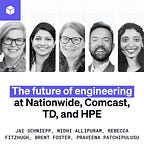
In this session from DX Annual, Rebecca Fitzhugh, Lead Principal Engineer at Atlassian, moderates a panel featuring Nidhi Allipuram, Vice President, Enterprise Developer Experience and Platform at Nationwide, Jai Schniepp, Senior Director, DevX Product Management at Comcast, Brent Foster, Vice President and Head of Architecture and Strategy at TD Bank, and Praveena Patchipulusu, Vice President of Engineering at HPE.
Together, they discuss how large enterprises are approaching AI adoption, what it takes to build an AI-first software development lifecycle, and how engineering leaders are balancing speed, security, governance, and developer experience. They also share their perspectives on the changing role of engineers, human accountability, and how organizations can prepare for the future of software engineering.
Some takeaways:
Building an AI-first software development lifecycle
AI adoption is becoming a redesign effort, not a tooling effort. Several panelists argued that the biggest opportunity is not simply adding AI assistants to existing workflows but rethinking the software development lifecycle itself. Rather than treating AI as a coding tool, organizations are beginning to integrate it into requirements gathering, design, testing, code reviews, and deployment.
Training and organizational support matter more than tool selection. Nationwide found that productivity gains came less from introducing new tools and more from providing engineers with training, coaching, playbooks, and time to learn. Teams consistently reported that air cover, psychological safety, and opportunities to experiment were more valuable than access to additional AI products.
Successful adoption requires systems, not mandates. Organizations cannot simply tell teams to “go use AI.” Several panelists described building AI champion programs, governance models, embedded coaching, and structured learning opportunities that help teams develop new habits and scale adoption across large enterprises.
Keeping humans accountable
Humans remain responsible for outcomes regardless of who writes the code. Every panelist emphasized that accountability does not shift to AI. Whether code is generated by an engineer, a copilot, or an agent, humans remain responsible for validating outputs, making decisions, and owning the results delivered to customers.
Validation is becoming more important than approval. Traditional approval processes may matter less than ensuring the right people validate assumptions, outcomes, and risks. Teams are increasingly focused on creating workflows where humans review and challenge AI-generated work rather than simply acting as signoff gates.
Decision-making is becoming a core engineering skill. As AI takes over more implementation work, engineers are spending more time evaluating tradeoffs, validating outputs, and making judgment calls. The ability to make good decisions quickly may become a larger differentiator than the ability to manually write code.
Security and governance in an AI-powered world
Shift-left practices become even more important with AI. Security, compliance, and quality checks are being pushed earlier into the development process. Rather than relying on reviews at the end of the pipeline, organizations are embedding guardrails directly into workflows and development platforms.
AI-generated infrastructure introduces new challenges. The conversation extended beyond application code to infrastructure. As AI increasingly generates Terraform, YAML, and cloud configuration files, organizations must build policy-driven validation and security controls to prevent vulnerabilities from entering production environments.
Context is both a powerful asset and a potential risk. One of AI’s greatest strengths is its ability to use organizational knowledge and historical context. At the same time, exposing that information to AI systems creates new security concerns, making governance and access controls increasingly important.
The changing role of the engineer
Engineers are becoming orchestrators rather than implementers. As AI takes over more boilerplate work, engineers are expected to focus more on system design, architecture, critical thinking, and coordinating work across humans, agents, and platforms. Success increasingly depends on defining intent and evaluating outcomes rather than writing every line of code manually.
Role boundaries are becoming less rigid. The panel described a future where engineers, product managers, designers, and other builders work more closely together. AI is making it easier for individuals to contribute across traditional functional boundaries, creating smaller teams with broader responsibilities.
Critical thinking and creativity become more valuable. While AI can accelerate execution, it cannot replace human judgment and problem framing. Several panelists argued that creativity, curiosity, and the ability to think differently about problems will become increasingly important as AI capabilities continue to improve.
Rethinking developer experience
Developer experience is becoming workflow experience. The focus is shifting from individual tools toward creating trusted workflows that help teams move from idea to production more quickly. Organizations are increasingly measuring success by how effectively teams can deliver outcomes rather than by how efficiently they write code.
Developer experience now includes agent experience. As AI agents become active participants in software delivery, organizations must consider how agents consume context, operate within guardrails, and interact with development platforms. Designing effective systems now means thinking about both human and AI users.
Breaking down silos creates better outcomes. Several panelists argued that AI provides an opportunity to reduce friction between product managers, designers, developers, and security teams. The organizations that benefit most may be those that remove barriers between disciplines and enable more collaborative ways of working.
Preparing for the future
The time to experiment is now. Every panelist encouraged organizations to begin learning through direct experience rather than waiting for the technology to mature. Teams that develop AI skills, workflows, and governance practices today will be better positioned as the technology continues to evolve.
Institutional knowledge may become a competitive advantage. Large enterprises possess decades of documentation, decisions, diagrams, and expertise that often remain difficult to access. Several speakers highlighted the opportunity to unlock that knowledge and make it useful through AI-powered systems.
Fundamentals still matter. Despite rapid technological change, the panel repeatedly returned to the same conclusion: strong engineering fundamentals, sound judgment, accountability, security practices, and critical thinking remain essential regardless of how much AI enters the software development process.
In this episode, we cover:
(00:00) Intro
(02:28) The AI journey across TD Bank, Comcast, and HPE
(05:59) Inside Nationwide’s AI-assisted development lifecycle
(10:04) Reimagining the software development lifecycle with AI
(11:32) Security, governance, and human accountability
(15:27) Embedding security and guardrails into AI workflows
(17:55) How AI is changing the role of an engineer
(21:52) What developer experience looks like in the AI era
(26:55) What software engineering may look like in 2030
(32:47) How to prepare for the AI-driven future
Where to find Rebecca Fitzhugh:
• LinkedIn: https://www.linkedin.com/in/rmfitzhugh
• X: https://x.com/RebeccaFitzhugh
Where to find Jai Schniepp:
• LinkedIn: https://www.linkedin.com/in/jessicaschniepp
Where to find Nidhi Allipuram:
• LinkedIn: https://www.linkedin.com/in/nidhi-allipuram
Where to find Brent Foster:
• LinkedIn: https://www.linkedin.com/in/engineeringthefuture
• Website: https://brentfoster.me
Where to find Praveena Patchipulusu:
• LinkedIn: https://www.linkedin.com/in/praveena-patchipulusu-158741
Referenced:
• TD Bank
• Hewlett Packard Enterprise (HPE)
• Abi Noda