
Listen and watch now on YouTube, Apple, and Spotify.
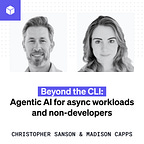
In this session from DX Annual, Christopher Sanson, Product Lead, AI Developer Experience, and Madison Capps, Engineering Manager, Infrastructure at Airbnb, challenge some of the most common assumptions about AI. Is AI primarily about replacing humans? Do organizations need mandates to drive adoption? And are the productivity gains really as small as some studies suggest?
Using examples from Airbnb’s own AI journey, they share how the company achieved widespread adoption of agentic AI through AirChat, community enablement, and internal tooling rather than top-down mandates. They also discuss the impact AI is having on developer productivity, how non-developers are increasingly using coding tools, and how teams are rethinking product development in an AI-first world.
Finally, Madison takes a deeper look at the infrastructure powering Airbnb’s AI strategy, including AirChat CLI, the AirChat SDK, and AirChat Remote, along with the company’s vision for asynchronous agent workflows and the next generation of AI-powered development.
Some takeaways:
AI adoption at scale
Successful AI adoption does not require mandates. Airbnb achieved 97% weekly usage and 90% daily usage of agentic AI tools among engineers without tying adoption to performance reviews or quotas. Christopher argued that the best adoption comes when developers choose to use AI because it genuinely helps them work faster and better.
Treat internal AI tools like products, not internal infrastructure. Airbnb built a recognizable brand around AirChat, invested in onboarding and workshops, created internal marketing materials, and focused heavily on user experience. That product mindset helped turn AirChat into a company-wide platform rather than just another engineering tool.
Community-driven learning scales better than centralized training. AI champions, train-the-trainer programs, hackathons, workshops, and active peer-to-peer learning channels allowed knowledge to spread organically across the company. Over time, the AI community became larger and more active than the team managing the platform itself.
Productivity gains are accelerating
Developers are spending more time actively coding. Christopher challenged the idea that engineers only spend a small percentage of their time writing code. As coding becomes faster and easier with agentic AI, developers can spend more of their week building software rather than working around implementation bottlenecks.
The most active AI users see the largest productivity gains. Airbnb found that developers who spent four or more hours per day working with agentic AI dramatically increased their output. The relationship between AI usage and productivity became stronger as engineers learned how to incorporate agents into their daily workflows.
PR throughput increased by 65% after the introduction of agentic AI. Airbnb’s data suggests that productivity gains extend well beyond the single-digit improvements often cited in industry studies. Developers who heavily embraced agentic AI moved from industry-average output to some of the highest throughput levels measured internally.
AI-authored code is becoming mainstream. Roughly 59% of Airbnb’s code is now primarily authored by AI, and more than half of developers report that AI generates the majority of the code they work with. Christopher argued that this shift is happening far faster than most organizations realize.
AI is spreading beyond engineering
The addressable market for AI is much larger than developers alone. Airbnb initially expected adoption to level off around its engineering population. Instead, usage continued growing as product managers, designers, finance teams, and operations teams began integrating agentic AI into their work.
People will learn new workflows when the value is obvious. Some non-engineering teams adopted VS Code and terminal-based tools simply because they provided the best access to agentic AI capabilities. Rather than resisting technical tools, employees were willing to learn them in exchange for meaningful productivity gains.
Domain experts are increasingly building their own AI-powered solutions. Airbnb’s internal platforms allow teams to create specialized applications tailored to their own workflows. This shifts more problem-solving into the hands of the people closest to the business problem.
Rethinking how work gets done
Many existing processes were designed around expensive software development. Product reviews, lengthy requirements documents, and sequential handoffs evolved in a world where implementation was slow and costly. AI changes those economics and creates opportunities to redesign workflows from first principles.
AI enables faster movement from ideas to prototypes. Rather than spending weeks refining specifications before building anything, teams can generate multiple prototypes quickly, test ideas earlier, and iterate before committing significant resources.
Smaller teams can collaborate earlier and move faster. Airbnb sees opportunities to reduce handoffs between product managers, designers, and engineers by bringing teams together earlier in the process and using AI to accelerate exploration and execution.
Building for asynchronous AI
Current agentic AI tooling still creates friction. Managing multiple sessions, handling long-running tasks, maintaining context, and switching between workflows remain cumbersome despite major advances in model capabilities.
The next frontier is asynchronous agent workflows. Rather than interacting with a single agent in real time, developers are increasingly orchestrating multiple agents working in parallel, often across long-running tasks that continue without constant supervision.
Airbnb is investing in infrastructure, not just models. AirChat CLI, migration tooling, the AirChat SDK, and AirChat Remote were all built around the belief that future gains will come from workflow orchestration, platform capabilities, and developer experience as much as from improvements in foundation models.
Preparing for an AI-first future
Organizations should build for where developer workflows are heading. Madison described Airbnb’s approach as continuously forecasting how engineers are likely to work in the near future and investing in the infrastructure required to support those workflows before they become mainstream.
AI-first architecture will become increasingly important. As throughput rises and more work is delegated to agents, teams will need stronger guardrails, scalable platforms, and systems designed specifically to support AI-assisted development.
The biggest bottlenecks are shifting away from code generation. As AI reduces implementation costs, constraints move elsewhere in the system. Coordination, validation, infrastructure, and workflow management are becoming the new challenges organizations must solve.
In this episode, we cover:
(00:00) Intro
(01:37) Myth #1: AI is about replacing humans
(03:22) Myth #2: You need mandates to drive AI adoption
(05:21) AirChat, agentic AI, and Airbnb’s adoption strategy
(08:07) Myth #3: AI has little impact on productivity
(09:33) Airbnb’s increase in coding time and PR throughput
(14:20) Myth #4: AI coding tools are just for coders
(15:39) How non-developers are using coding tools
(17:24) Rethinking product development in an AI-first world
(20:30) Myth #5: Vibe coding isn’t coding
(22:16) Unsolved problems in agentic AI tooling and how Airbnb is addressing them
(26:30) Airbnb’s overall AI philosophy in practice
(29:15) Using agentic AI to accelerate code migrations
(30:18) AirChat SDK: How Airbnb enables teams to build AI-powered applications
(33:17) AirChat Remote and asynchronous agent workflows
(36:07) Predictions for what’s next
Where to find Christopher Sanson:
• LinkedIn: https://www.linkedin.com/in/christophersanson
Where to find Madison Capps:
• LinkedIn: https://www.linkedin.com/in/madison-capps-66950625
Referenced:
• Airbnb
• Steve Jobs’s Bicycles for the Mind