Listen and watch now on YouTube, Apple, and Spotify.
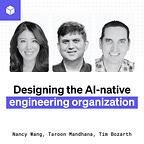
Abi Noda is joined live at DX Annual by three engineering leaders shaping AI adoption at scale: Tim Bozarth, Corporate Vice President in Microsoft’s CoreAI division; Nancy Wang, CTO of 1Password; and Taroon Mandhana, CTO of AI and Teamwork at Atlassian. Together, they discuss how AI is changing engineering organizations, from team structures and planning cycles to hiring, governance, and measurement.
The panel explores how the profile of a great engineer is evolving, why smaller cross-functional teams are becoming more effective, and what happens when product managers, designers, and customer support teams start contributing code. They also share why they are encouraging AI adoption through enablement, training, and local champions rather than mandates, and how AI is shifting more of the software development lifecycle toward planning and validation.
Finally, they discuss where human judgment remains essential, how to measure adoption and manage token usage, and how to connect AI investments to business outcomes while preserving room for experimentation and learning.
Some takeaways:
Rethink team structures for faster learning
Smaller teams are becoming more effective for zero-to-one work. AI reduces the cost of implementation, making alignment and rapid iteration the primary bottlenecks when searching for product-market fit.
Planning cycles are getting shorter. Instead of locking in 12- to 18-month roadmaps, teams are shifting toward quarterly planning to adapt more quickly to changing technology and market conditions.
Large-scale org changes can wait. Several panelists emphasized that experimentation and learning should come before major structural redesigns.
The best engineers think like makers
A maker’s mindset matters more than mastery of a specific tool. The most effective engineers stay focused on outcomes and use whatever tools help them build valuable products.
Product and engineering skills are converging. Strong engineers increasingly combine technical depth with product judgment, customer empathy, and design sensibility.
Agency is becoming a defining trait. Engineers who can work across functions, navigate ambiguity, and drive decisions are gaining leverage as AI handles more of the implementation work.
Expect more people to participate in software creation
Prototypes are replacing long-form requirements documents. Interactive demos often lead to faster and more productive conversations than detailed specifications.
Product managers, designers, and customer support teams are starting to write code. AI is lowering the barrier for non-engineers to contribute directly to the software development lifecycle.
Quality systems become more important as more people contribute code. Robust tests, review processes, and deployment safeguards are essential when more people can generate production code.
Drive adoption through enablement, not mandates
Outcomes matter more than activity. The goal is not maximizing AI usage for its own sake, but improving speed, ease, and product quality.
Local champions accelerate adoption. Teams learn fastest when respected peers demonstrate practical ways to use AI in real workflows.
Activity metrics are diagnostic, not the objective. Low usage can signal where teams need more training, support, or better tools.
The AI-native SDLC shifts work toward planning and validation
Plan and validate are becoming the highest-leverage activities. As AI accelerates code generation, more human effort shifts toward defining what to build and evaluating whether it meets expectations.
Operations and incident response are ripe for automation. Engineering teams are beginning to use AI to triage alerts, investigate incidents, write postmortems, and reduce the time spent on routine operational work.
Human judgment remains essential. Leaders were unanimous that critical decisions around quality, security, and accountability still require people in the loop.
Measure outcomes, costs, and learning
Token usage is becoming the new cloud bill. Engineering leaders are applying FinOps-style discipline to monitor and forecast AI spending.
North Star metrics provide a clearer signal. Examples include idea-to-value, innovation time, and product quality.
Experimentation deserves budget. Some AI usage will not generate immediate ROI, but it can create learning that compounds into long-term competitive advantage.
In this episode, we cover:
(00:00) Intro
(01:08) Introducing the panelists
(02:16) AI’s impact on engineering team structures and planning cycles
(05:00) How the role of the engineer is changing and what makes a great engineer
(10:11) The opportunities and challenges of non-engineers writing code
(15:26) Encouraging AI adoption without mandating it
(21:25) What an AI-native SDLC looks like and why human judgment still matters
(30:56) Measuring AI adoption, token usage, and ROI
(37:06) How to tie AI investments to business outcomes
Where to find Nancy Wang:
• LinkedIn: https://www.linkedin.com/in/wangnancy
Where to find Taroon Mandhana:
• LinkedIn: https://www.linkedin.com/in/taroonm
Where to find Tim Bozarth:
• LinkedIn: https://www.linkedin.com/in/tbozarth
Where to find Abi Noda:
• LinkedIn: https://www.linkedin.com/in/abinoda
Referenced:
• DX Core 4 Productivity Framework
• Jira
• Loom
• Rovo